What Are Eco-Friendly Cleaning Products? (2026 Guide)
October 14, 2026 · 10 min read · By Queen Creek House Cleaning
Eco-friendly cleaning products combine biodegradable, plant-based ingredients with low volatile organic compound (VOC) formulas and sustainable packaging designed to be recycled, reused, or refilled. The catch: "eco-friendly," "green," and "natural" aren't legally regulated terms for cleaning products the way "organic" is for food. That means brands can slap a leaf on a bottle without changing a single ingredient.
I've spent years walking into homes across Queen Creek with a cleaning caddy, and I can tell you the gap between marketing language and real substance is exactly what separates products worth buying from expensive greenwashing. Some brands genuinely rebuild their formulas around ingredients that break down safely and packaging that doesn't pile up in a landfill. Others just ride the trend.
Knowing the difference matters if you care about indoor air quality, your water system, or just not being fooled by a pretty label.
What Defines Eco-Friendly Cleaning Products
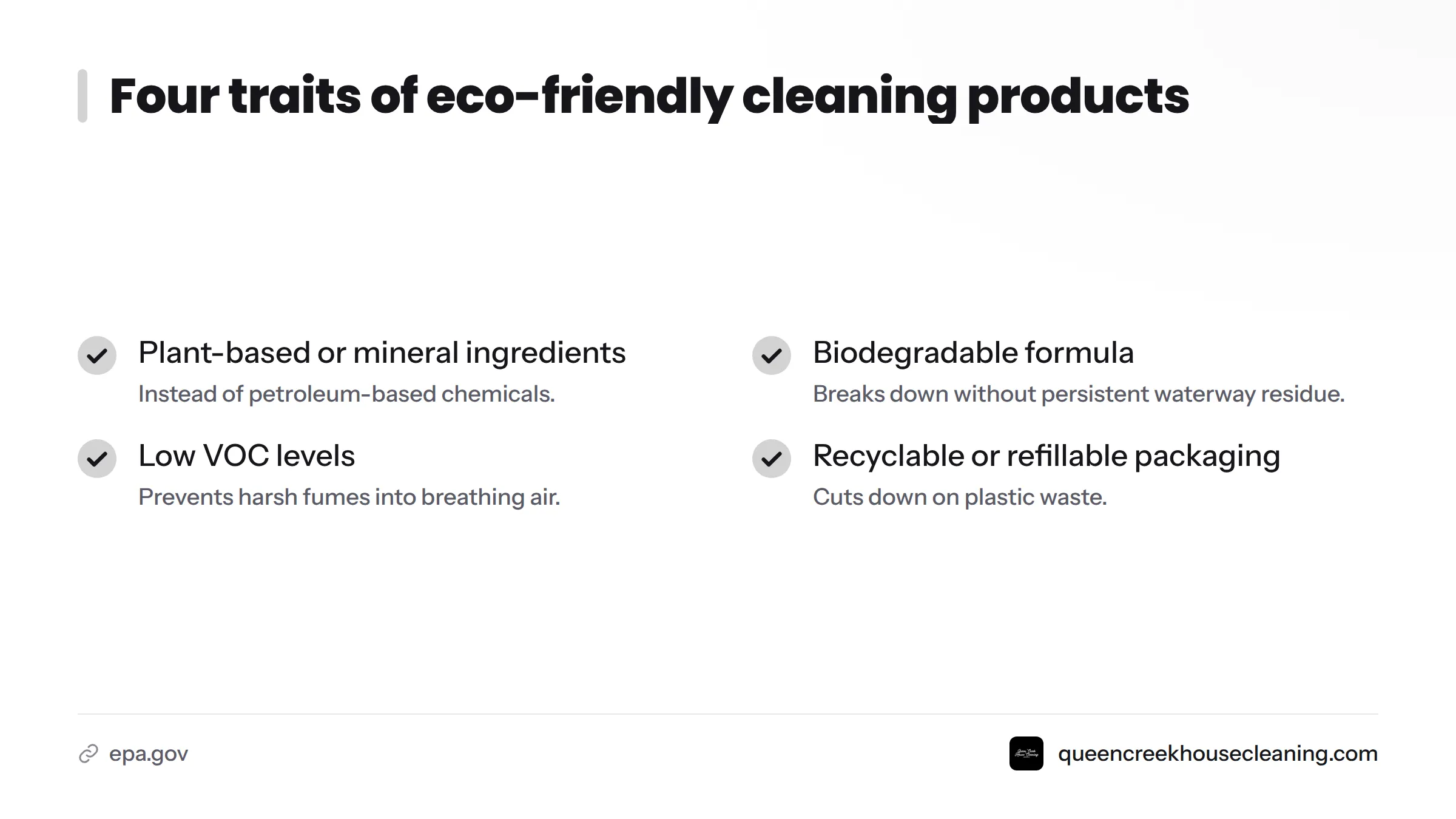
At the core, eco-friendly cleaning products share a few traits: they use plant-based or mineral-derived ingredients instead of petroleum-based chemicals, they biodegrade without leaving persistent residue in waterways, they keep VOC levels low so they don't off-gas harsh fumes into your breathing air, and they typically ship in recyclable, refillable, or concentrated packaging that cuts down on plastic waste.
Greenwashing thrives because the terms lack legal definition. The U.S. Environmental Protection Agency directly addresses this gap in its guidance on identifying greener cleaning products, recommending that you look past marketing claims and check for verified ecolabels, full ingredient disclosure, and safety data instead of taking the package's word for it.
Quick definition: Eco-friendly cleaning products combine biodegradable, plant-based ingredients with low-VOC formulas and sustainable packaging, verified where possible by third-party ecolabels rather than self-made claims.
The Standards We Actually Use
Running a professional cleaning business in Queen Creek means I can't just trust a label. Every product that goes into our team's caddies clears an internal standard before it touches a client's home.
Ingredient Sourcing: We look for plant-derived surfactants over petroleum-based ones, full ingredient transparency on the manufacturer's site, and a track record of third-party verification rather than vague "eco" branding. If a company won't disclose what's in the bottle, it doesn't make the cut.
Packaging and Waste: Refillable bottles and concentrate systems beat single-use plastic spray bottles every time. Concentrated formulas also mean fewer delivery trips and less packaging waste overall, which fits naturally into how we run our eco-friendly house cleaning service across town.
Performance: A product has to actually clean. Queen Creek homes deal with real desert dust, hard water spots, and stubborn grime, so an eco-friendly formula still has to cut through grease and lift mineral buildup, not just smell nice while leaving a film behind.
Our 5-Point Sourcing Checklist
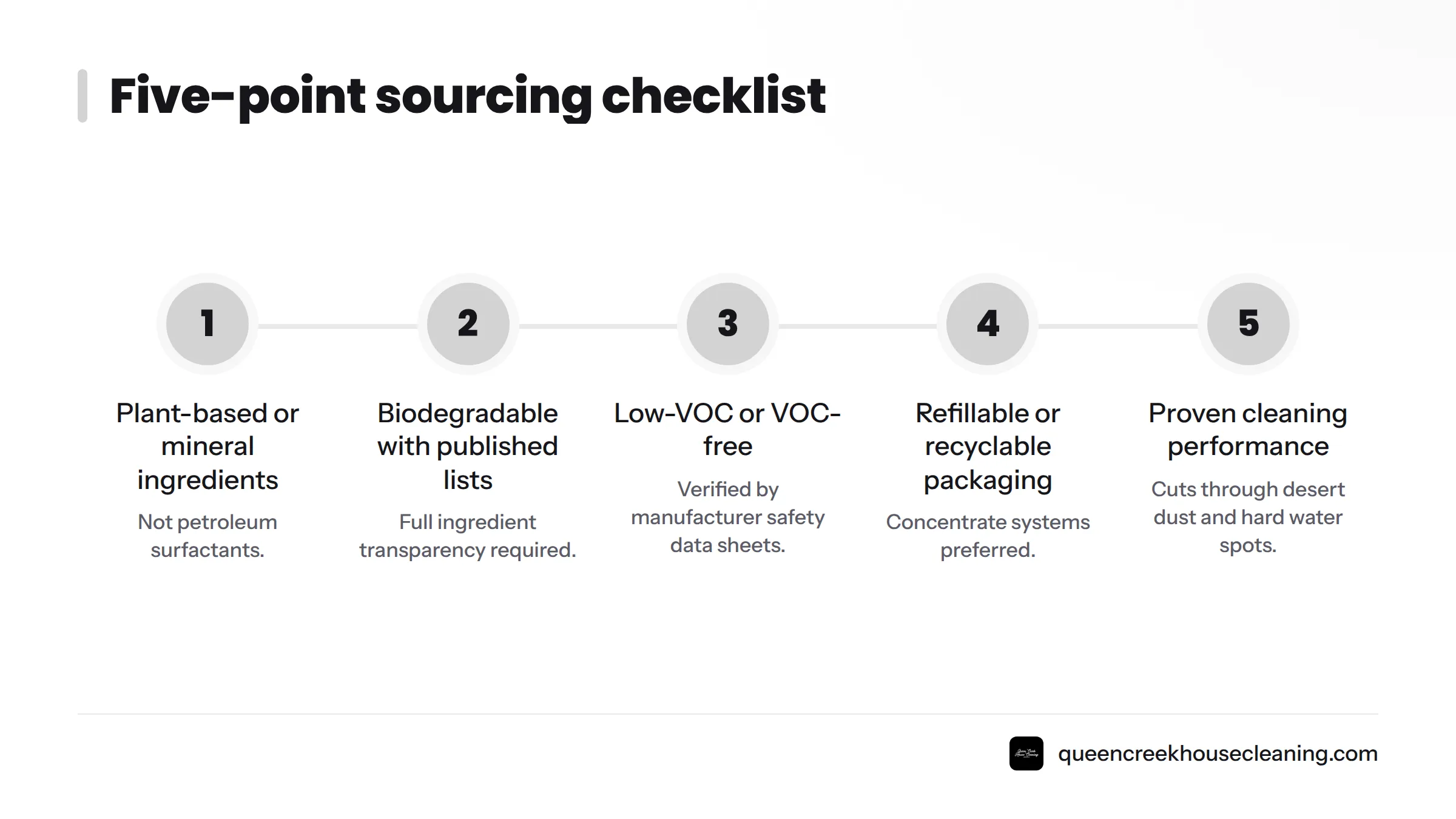
- Plant-based or mineral-derived active ingredients, not petroleum surfactants
- Biodegradable formula with published ingredient lists
- Low-VOC or VOC-free, verified by manufacturer safety data sheets
- Refillable, concentrated, or recyclable packaging
- Proven cleaning performance on real desert-home grime, not just lab claims
Product Categories and Desert Conditions
Different rooms and surfaces call for different formulas, and what performs well in Queen Creek's climate matters more than most people realize.
All-Purpose and Surface Cleaners handle countertops, cabinet fronts, and everyday wipe-downs. Plant-based surfactant formulas cut through the fine dust film that settles on every horizontal surface in a Valley home within days.
Glass and Mirror Cleaners need low-VOC, streak-free formulas because glass surfaces show every bit of dust Queen Creek's wind kicks up. A biodegradable, ammonia-free formula gets the same clarity without the fumes.
Floor Cleaners vary by surface - tile, wood, and laminate all need different approaches. The desert dust problem plays a bigger role than most homeowners realize. If you want the full picture on why local homes collect grit so fast, our breakdown of why Queen Creek homes get so dusty explains the climate factors behind it.
Microfiber Cloths and Reusable Tools aren't chemicals, but they belong in this conversation because they reduce paper towel waste and, in many cases, let us use less cleaning solution per surface since the fiber itself lifts dust and grime mechanically.
Concentrated and Refillable Formulas ship smaller, generate less plastic per use, and let our team dilute to the right strength on site. It's one of the simplest ways a cleaning product line can shrink its footprint without changing what's actually in the bottle.
Ingredients and Packaging Worth Choosing
| Look For | Why It Matters |
|---|---|
| Plant-based surfactants | Break down faster, derived from renewable sources instead of petroleum |
| Biodegradable formula | Breaks down safely without persisting in waterways |
| Phosphate-free | Prevents nutrient runoff that fuels algae blooms in lakes and rivers |
| Low-VOC or VOC-free | Reduces indoor air pollutants and off-gassing |
| Fragrance-free or naturally scented | Avoids synthetic fragrance chemicals while still smelling clean |
| Recyclable or refillable packaging | Cuts down on single-use plastic waste |
| Concentrated formulas | Less packaging and shipping weight per use |
Fragrance-free means no scent additives at all. Naturally scented means the scent comes from essential oils or plant extracts rather than synthetic blends. Both avoid the undisclosed synthetic fragrance chemicals that many conventional cleaners rely on.
Phosphate-free matters plainly: phosphates used to soften water and boost cleaning power, but they feed algae overgrowth when they wash into lakes and streams, which depletes oxygen and harms aquatic life. Most municipal and state regulations have phased phosphates out of household cleaners for exactly that reason.
Red Flags to Skip
| Red Flag | Why We Avoid It |
|---|---|
| Vague "natural" claims with no ingredient list | Unregulated term, often meaningless without disclosure |
| High-VOC aerosols | Release more airborne pollutants, linked to poor indoor air quality |
| Non-biodegradable synthetic surfactants | Persist in wastewater systems longer |
| Excessive single-use plastic packaging | Works against the sustainability the product claims to offer |
| Undisclosed "fragrance" or "parfum" blends | Can mask dozens of unlisted synthetic chemicals |
The biggest trap for homeowners is the standalone word "natural." It has no legal definition, so a cleaner can call itself natural while still containing synthetic preservatives or undisclosed fragrance chemicals. The EPA specifically recommends checking for recognized ecolabels like Safer Choice or Green Seal instead of trusting a single word on the front label.
How We Apply These Standards to Every Job
Eco-friendly supplies aren't a separate add-on. They're built into standard, recurring, deep, and move-in/move-out cleanings alike. A standard visit uses the same plant-based all-purpose sprays and microfiber system as a full deep clean, just scaled to the job. For move-out cleans, where every cabinet, baseboard, and window track gets attention, concentrated formulas let us carry fewer bottles while still having enough product for a whole house.
If you're trying to figure out which service level your home actually needs, our guide comparing deep cleaning vs standard cleaning breaks down what each one covers.
Here's a short video that walks through how a cleaning business approaches the shift toward greener products in daily operations, which mirrors a lot of what goes into our own sourcing decisions.
https://www.youtube.com/watch?v=JW8ZphahlUo
Eco-Friendly vs. Traditional Cleaning Products
| Feature | Eco-Friendly Products | Traditional Products |
|---|---|---|
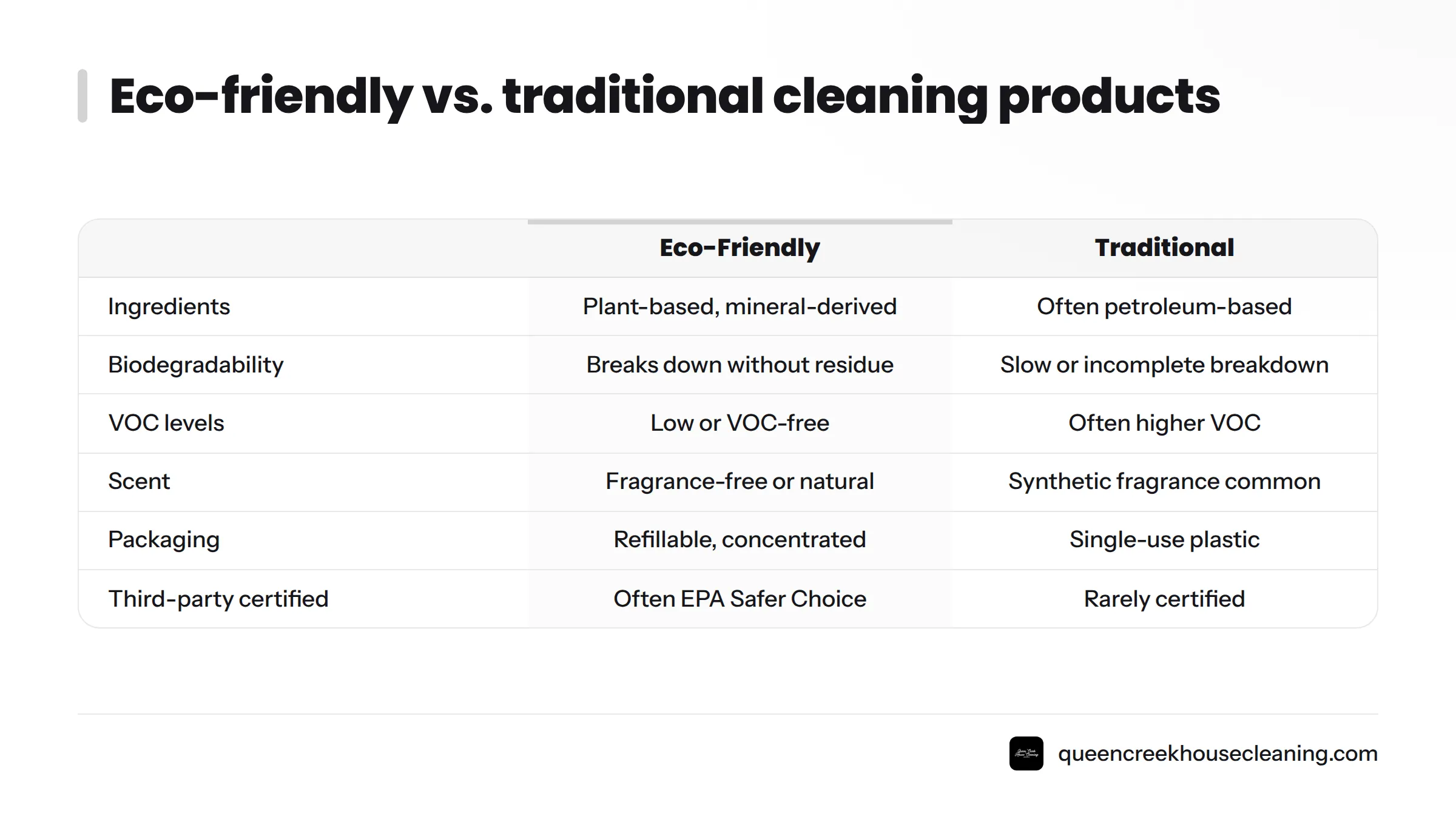
| Ingredients | Plant-based, mineral-derived | Often petroleum-based |
| Biodegradability | Breaks down without persistent residue | Many surfactants break down slowly or incompletely |
| VOC levels | Low or VOC-free | Often higher VOC content |
| Scent | Fragrance-free or naturally scented | Synthetic fragrance common |
| Packaging | Refillable, concentrated, recyclable | Frequently single-use plastic |
| Phosphates | Phosphate-free | Historically more common, now regulated in many states |
| Certification | Often EPA Safer Choice or Green Seal verified | Rarely third-party certified |
Performance is the question people ask most, and it's a fair one. A well-formulated eco-friendly cleaner, built with enzyme blends or plant-derived surfactants, can absolutely cut grease and lift grime as effectively as a conventional formula. The gap that used to exist between "green" and "actually works" has narrowed significantly over the past decade as manufacturers have improved plant-based surfactant chemistry.
Common Questions About Eco-Friendly Cleaning Products
What are the best environmentally friendly cleaning products? The best options combine plant-based ingredients, low-VOC formulas, and recyclable or refillable packaging, ideally backed by a third-party ecolabel like EPA Safer Choice or Green Seal. Rather than one single "best" brand, look for products that meet all four criteria together.
Is Mrs. Meyer's actually non-toxic? "Non-toxic" isn't a regulated term, so the honest answer depends on which specific product and ingredient list you're checking. The best approach is reviewing the manufacturer's published ingredient disclosure against recognized criteria like those in the EPA's greener products guidance rather than relying on the brand name alone.
What are examples of eco-friendly cleaning products? Common categories include plant-based all-purpose sprays, biodegradable glass cleaners, concentrated floor cleaners, phosphate-free dish soap and laundry detergent, and reusable microfiber cloths that cut down on paper towel waste.
How can I clean my house without chemicals? You can't eliminate chemistry entirely since even water and vinegar are chemical compounds, but you can choose plant-based, biodegradable, low-VOC formulas over synthetic, petroleum-based ones. Pair that with microfiber cloths to reduce how much product you need per surface.
What should I avoid when a product claims to be "natural"? Avoid trusting the word alone. Check for a full ingredient list, confirm there's no undisclosed "fragrance" blend hiding synthetic chemicals, and look for a recognized ecolabel rather than taking a single marketing claim at face value.
Why does desert dust in Queen Creek matter when choosing cleaning products? Fine desert dust settles fast and can require more frequent surface cleaning, so a product's real-world cutting power matters as much as its ingredient list. Our piece on why desert dust is harder on Queen Creek homes covers the specific climate conditions driving that buildup.
If your household includes kids or pets and you want more detail on which formulas tend to work best in those homes, our guide to eco-friendly cleaning products safe for kids and pets picks up where this one leaves off, and our broader piece on eco-friendly cleaning products that are safe for family rounds out the family-focused side of this topic.
The Bottom Line
Choosing genuinely eco-friendly cleaning products comes down to checking the same things every time: plant-based ingredients, biodegradability, low VOCs, honest packaging, and real third-party verification instead of a single word on the front label. That's the same standard we hold our own supplies to before they ever go into a client's home.
If you'd rather hand the whole process off, you can learn more about how our team applies these standards on every job through our eco-friendly house cleaning service, built for homes right here in Queen Creek.
Sources
Ready to book your cleaning?
Book a Cleaning